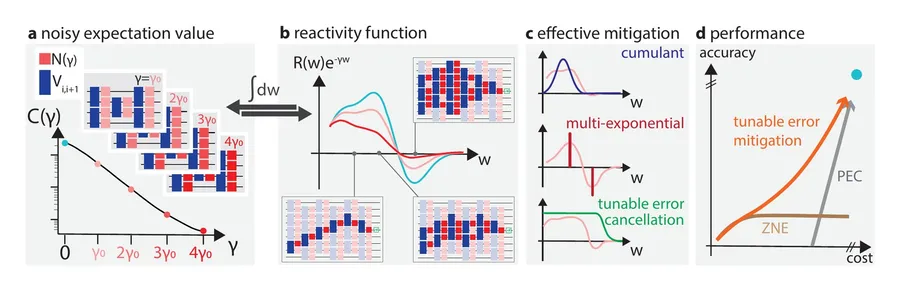
A circuit's reactivity function is a compact representation of how information spreads through it; its shape governs how the circuit responds to noise and which mitigation methods suit it. On three circuit families taken from published experiments, two tunable methods built on it overcome conventional zero-noise-extrapolation biases as large as 30% and, at about 10^-2 RMS error, reduce sampling cost by up to a factor of 10^3 relative to probabilistic error cancellation.
Scope. Methods tested numerically on circuit families taken from published experiments; not a new hardware experiment.
Abstract
Overcoming experimental errors is a central challenge in quantum science. This challenge is particularly acute in large and complex quantum circuits, where quantum information spreads into exponentially many paths, foiling any direct attempt to understand errors' impact. In this work, we present a novel approach to understanding and mitigating experimental errors, based on a surprisingly compact representation of a quantum circuit's information dynamics, the reactivity function. The shape of a circuit's reactivity function governs its noise response, and its amenability to different error mitigation methods. From this viewpoint, we introduce two complementary such methods. The first, Pauli-path zero-noise extrapolation, fits a parameterized model to a circuit's reactivity function and uses it to accurately extrapolate to zero noise. The second, tunable error cancellation, filters a circuit's reactivity function to cancel noise on all information up to a threshold locality. Crucially, both methods feature a tuning parameter that allows one to systematically improve their accuracy until convergence. Across three circuit families from published experiments, our methods overcome conventional zero-noise extrapolation biases as large as 30%; at $\sim$$10^-2$ root-mean-square error, they reduce sampling cost relative to probabilistic error cancellation by up to a factor of $10^3$.
The conversation
The explainer posts I wrote about this paper, in order.
- 2026-09-30Announcement
- 2026-10-04Reactivity in one picture
- 2026-10-05A compact effective reactivity
- 2026-10-07Filter design
- 2026-10-12PEC as a sum of experiments