Extracting electromagnetic couplings in large superconducting processors requires modeling scales from nanometer junctions to centimeter enclosures. Four numerical extraction methods (avoided crossing, energy participation, induced EMF and impedance matrix), built for commercial 3D solvers, give couplings to standing package modes with a maximum relative difference of less than 5% on a 10 × 10 transmon array.
Scope. Numerical extraction methods compared with each other on a simulated 10 × 10 array; not a measurement of a device.
Abstract
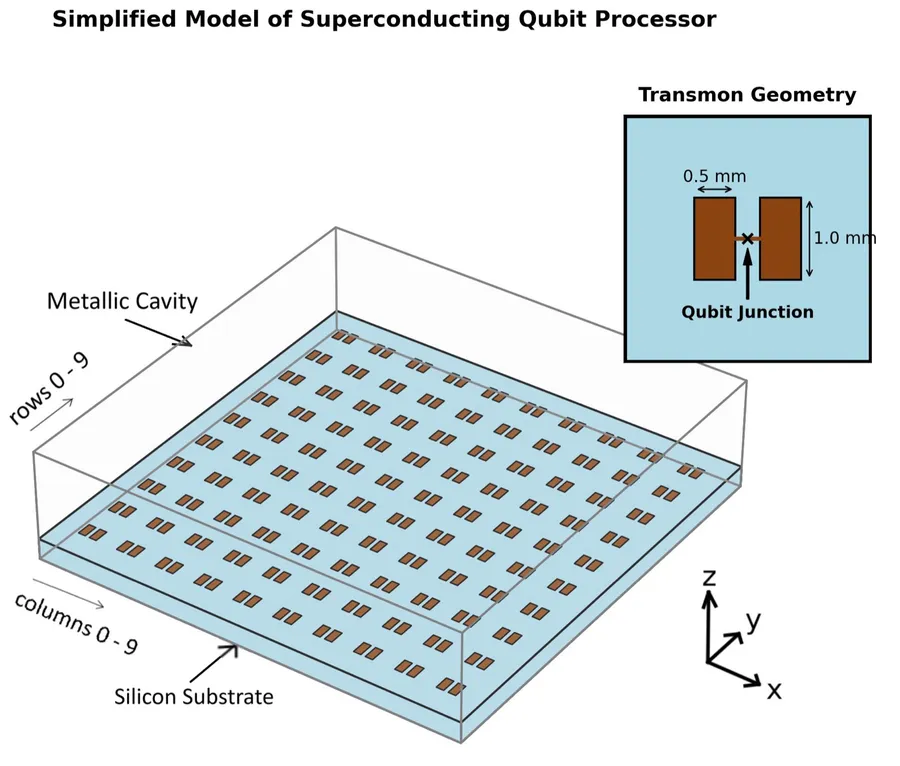
High-fidelity control of superconducting quantum processors requires accurate characterization of electromagnetic coupling strengths among the device's constituent elements. Accurately extracting these couplings across large-scale architectures, presently featuring hundreds of qubits, poses a challenging multi-scale modeling problem. This requires resolving scales from the nanometer-scale geometry of Josephson junctions and their leads to the centimeter-scale size of the enclosing metallic packages. We present four numerical coupling extraction methods based on the avoided level crossing, the energy participation ratio, the induced electromotive force, and the impedance matrix. These methods are tailored to work with commercially available 3D electromagnetic solvers. We benchmark these techniques on a $10\times10$ array of transmon qubits, extracting their couplings to standing package modes. Our results show that these methods yield consistent coupling strengths with a maximum relative difference of less than 5%.
The conversation
The explainer posts I wrote about this paper, in order.
- 2026-09-26Announcement
- 2026-09-27Why a horizontal dipole couples to a vertical package mode
- 2026-10-01The in-plane field, seen directly
- 2026-10-02Four methods, close agreement
- 2026-10-03Why package modes are a hundred-qubit problem
- 2026-10-04One eigenmode solve, one hundred couplings
- 2026-10-06The avoided crossing and the splitting 2|g|
- 2026-10-08Energy participation as a coupling probe
- 2026-10-10A circuit hidden in Z(ω)