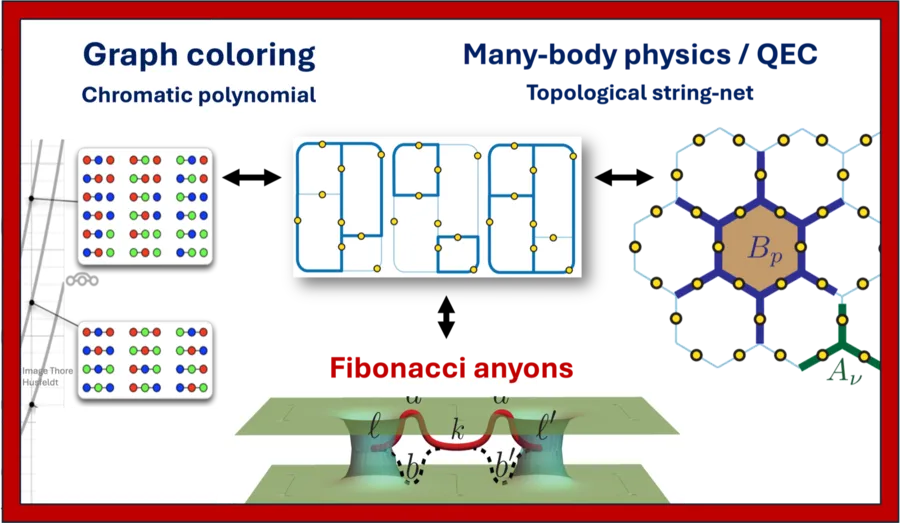
The Fibonacci string-net condensate, a proposed route to fault-tolerant universal quantum computation through anyon braiding, had remained out of reach. Dynamical string-net preparation with composite error mitigation prepares it on a superconducting processor and enables braiding its anyons, recovering the golden ratio with 98% average accuracy and 8% measurement uncertainty. Sampling the condensate also yields estimates of chromatic polynomials at φ+2 for several graphs, as a proof of principle.
Scope. Proof-of-principle experiment using error mitigation; not yet fault-tolerant.
Abstract
The remarkable complexity of the vacuum state of a topologically-ordered many-body quantum system encodes the character and intricate braiding interactions of its emergent particles, the anyons. Quintessential predictions exploiting this complexity use the Fibonacci string-net condensate (Fib-SNC) and its Fibonacci anyons to go beyond classical computing. Sampling the Fib-SNC wavefunction is expected to yield estimates of the chromatic polynomial of graph objects, a classical task that is provably hard. At the same time, exchanging anyons of Fib-SNC is expected to allow fault-tolerant universal quantum computation. Nevertheless, the physical realization of Fib-SNC and its anyons remains elusive. Here, we introduce a scalable dynamical string-net preparation (DSNP) approach, suitable even for near-term quantum processors, which dynamically prepares Fib-SNC and its anyons through reconfigurable graphs. Using a superconducting quantum processor, we couple the DSNP approach with composite error-mitigation on deep circuits to successfully create, measure, and braid anyons of Fib-SNC in a scalable manner. We certify the creation of anyons by measuring their `anyon charge', finding an average experimental accuracy of $94\%$. Furthermore, we validate that exchanging these anyons yields the expected golden ratio~$φ$ with~$98\%$ average accuracy and~$8\%$ measurement uncertainty. Finally, we sample the Fib-SNC to estimate the chromatic polynomial at~$φ+2$ for several graphs. Our results establish the proof of principle for using Fib-SNC and its anyons for fault-tolerant universal quantum computation and for aiming at a classically-hard problem.