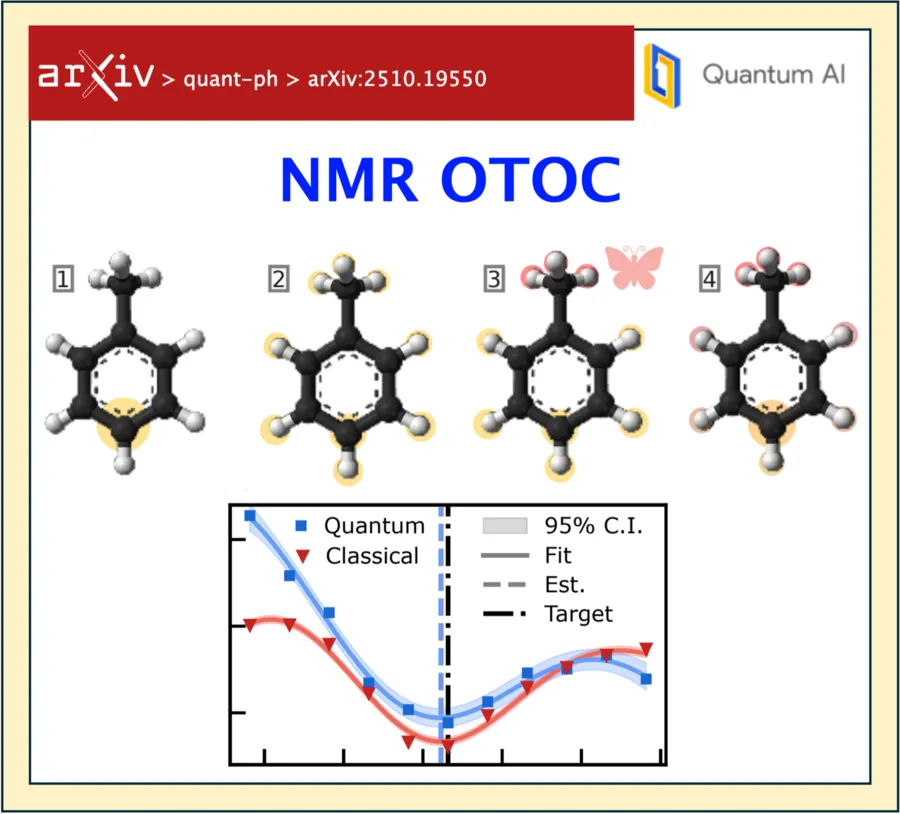
Many-body nuclear spin echoes (out-of-time-ordered correlators), measured by NMR on two molecules in a nematic liquid crystal, refine molecular dynamics models. The models estimate the mean ortho-meta H–H distance in toluene and the mean dihedral angle in 3′,5′-dimethylbiphenyl with accuracy and precision similar to independent spectroscopy. To address the apparent exponential classical cost of interpreting these data, the echoes are simulated on a Willow superconducting processor, with zero-noise extrapolation based on the Pauli pathing model of operator dynamics.
Scope. Proof of principle on two small molecules. The quantum-processor runs reproduce the learning task; they are not presented as a beyond-classical result for these instances.
I led the quantum error mitigation for this experiment.
Abstract
Quantum-information-inspired experiments in nuclear magnetic resonance spectroscopy may yield a pathway towards determining molecular structure and properties that are otherwise challenging to learn. We measure out-of-time-ordered correlators (OTOCs) [1-4] on two organic molecules suspended in a nematic liquid crystal, and investigate the utility of this data in performing structural learning tasks. We use OTOC measurements to augment molecular dynamics models, and to correct for known approximations in the underlying force fields. We demonstrate the utility of OTOCs in these models by estimating the mean ortho-meta H-H distance of toluene and the mean dihedral angle of 3',5'-dimethylbiphenyl, achieving similar accuracy and precision to independent spectroscopic measurements of both quantities. To ameliorate the apparent exponential classical cost of interpreting the above OTOC data, we simulate the molecular OTOCs on a Willow superconducting quantum processor, using AlphaEvolve-optimized [5] quantum circuits and arbitrary-angle fermionic simulation gates. We implement novel zero-noise extrapolation techniques based on the Pauli pathing model of operator dynamics [6], to repeat the learning experiments with root-mean-square error $0.05$ over all circuits used. Our work highlights a computational protocol to interpret many-body echoes from nuclear magnetic systems using low resource quantum computation.
Related talks
- 2026OTOC-NMR Experiment: Error Mitigation, Modeling and Results · APS March Meeting · slides in the Notebook