Probabilistic error cancellation removes noise bias from expectation values, given an accurate noise model. A practical protocol learns and inverts a sparse Pauli-Lindblad noise model that captures correlated noise and scales to large devices, enabling a demonstration on a superconducting processor with crosstalk errors.
Scope. Experimental demonstration on a superconducting processor with crosstalk. PEC needs an accurately learned noise model, and its sampling cost grows exponentially with the total noise in the circuit.
Abstract
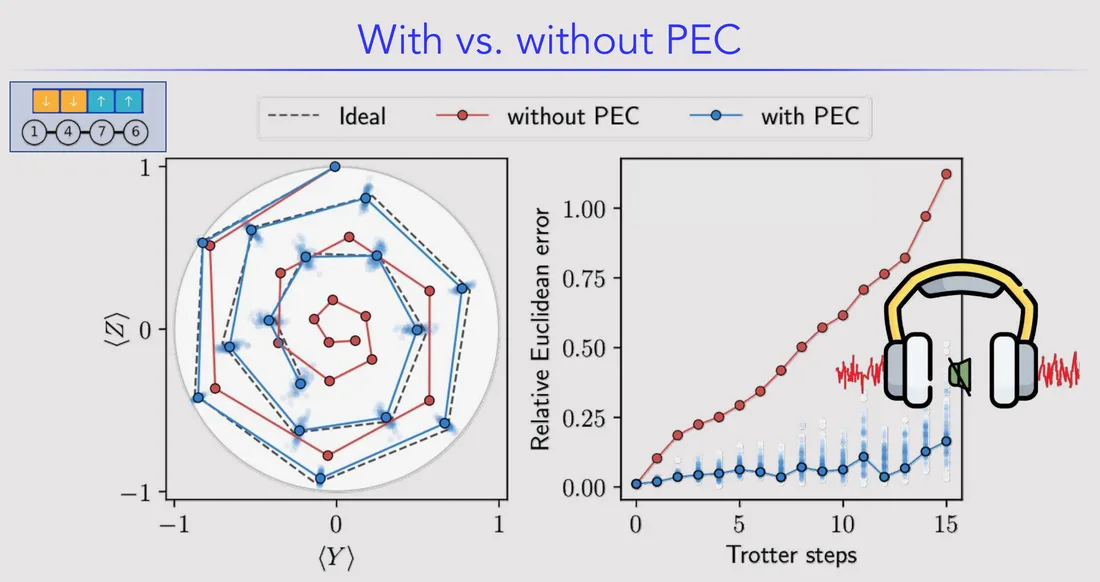
Noise in pre-fault-tolerant quantum computers can result in biased estimates of physical observables. Accurate bias-free estimates can be obtained using probabilistic error cancellation (PEC), which is an error-mitigation technique that effectively inverts well-characterized noise channels. Learning correlated noise channels in large quantum circuits, however, has been a major challenge and has severely hampered experimental realizations. Our work presents a practical protocol for learning and inverting a sparse noise model that is able to capture correlated noise and scales to large quantum devices. These advances allow us to demonstrate PEC on a superconducting quantum processor with crosstalk errors, thereby providing an important milestone in opening the way to quantum computing with noise-free observables at larger circuit volumes.
Related talks
- 2022To Learn and Cancel Quantum Noise: PEC with Sparse Pauli-Lindblad Models · IBM Quantum Qiskit Seminar · slides in the Notebook
- 2022To Learn and Cancel Quantum Noise: PEC with Sparse Pauli-Lindblad Models · KITP · slides in the Notebook