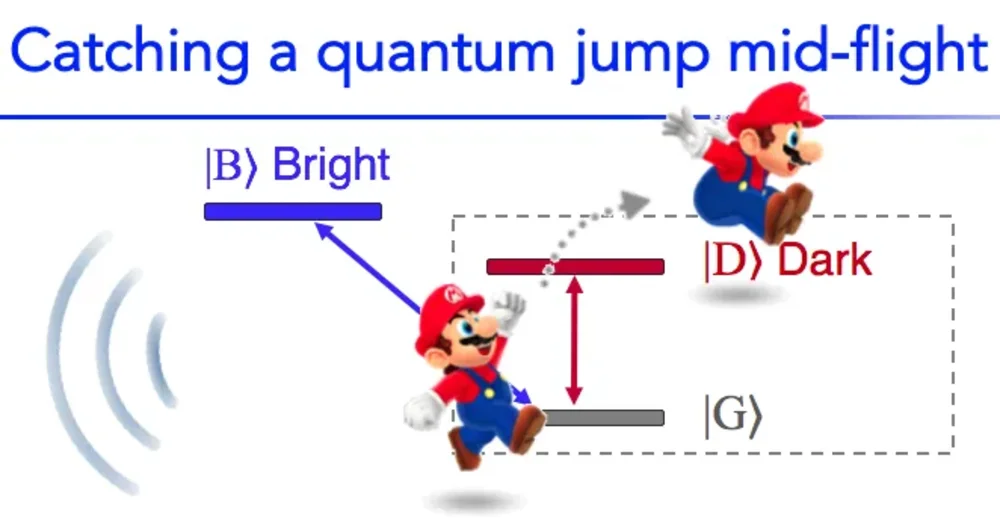
A superconducting three-level atom jumps at random times from its ground state to an excited state. Monitoring an auxiliary level coupled to the ground state gives advance warning of a jump: a completed jump follows a continuous, coherent and predictable flight, and real-time feedback catches and reverses jumps mid-flight.
Scope. Experiment on one superconducting artificial three-level atom. When a jump starts remains random; the experiment gives advance warning of a jump in progress and shows that a completed jump is continuous, coherent and deterministic.
Abstract
Quantum physics was invented to account for two fundamental features of measurement results -- their discreetness and randomness. Emblematic of these features is Bohr's idea of quantum jumps between two discrete energy levels of an atom. Experimentally, quantum jumps were first observed in an atomic ion driven by a weak deterministic force while under strong continuous energy measurement. The times at which the discontinuous jump transitions occur are reputed to be fundamentally unpredictable. Can there be, despite the indeterminism of quantum physics, a possibility to know if a quantum jump is about to occur or not? Here, we answer this question affirmatively by experimentally demonstrating that the jump from the ground to an excited state of a superconducting artificial three-level atom can be tracked as it follows a predictable "flight," by monitoring the population of an auxiliary energy level coupled to the ground state. The experimental results demonstrate that the jump evolution when completed is continuous, coherent, and deterministic. Furthermore, exploiting these features and using real-time monitoring and feedback, we catch and reverse a quantum jump mid-flight, thus deterministically preventing its completion. Our results, which agree with theoretical predictions essentially without adjustable parameters, support the modern quantum trajectory theory and provide new ground for the exploration of real-time intervention techniques in the control of quantum systems, such as early detection of error syndromes.
Related talks
- 2021To Catch and Reverse a Quantum Jump Mid-Flight · Yale Undergraduate Quantum Computing (YuQC) · slides in the Notebook
- 2020To Catch and Reverse a Quantum Jump Mid-Flight (broad talk) · MIT Technology Review EmTech (TR35) · slides in the Notebook