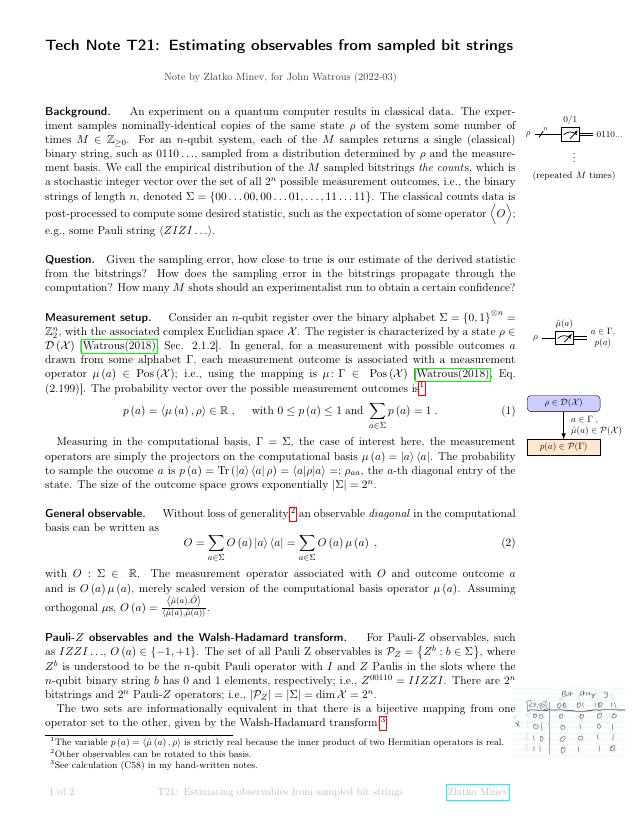
Computational-basis measurement of an n-qubit state relates bitstring probabilities to Pauli-Z expectations through the Walsh-Hadamard transform. The counts from M independent shots follow a multinomial distribution, whose mean and covariance provide a starting point for studying how sampling error propagates to estimated observables. The note remains a work in progress.
Measurement operators and outcome probabilities for an n-qubit register
Diagonal observables and Pauli-Z strings indexed by bitstrings
Walsh-Hadamard transform between projector and Pauli-Z expectations
Multinomial statistics of shot counts: mean and covariance
Summary and key points drafted by a language model from the slides, not yet reviewed by me. The slides are the source.
From the blog · 2022-06-16Tech Note T21: Estimating observables from sampled bit strings
Background.
An experiment on a quantum computer results in classical data. The experiment samples nominally-identical copies of the same state ρ of the system some number of times M ∈ Z ≥ 0 . For an n -qubit system, each of the M samples returns a single (classical) binary string, such as 0110 … , sampled from a distribution determined by ρ and the measurement basis. We call the empirical distribution of the M sampled bitstrings the counts, which is a stochastic integer vector over the set of all 2 n possible measurement outcomes, i.e., the binary strings of length n , denoted Σ ={ 00 … 00,00 … 01, … ,11 … 11 } . The classical counts data is post-processed to compute some desired statistic, such as the expectation of some operator ⟨ O ˆ ⟩ ; e.g., some Pauli string ⟨ ZIZI … ⟩ .
Question.
Given the sampling error, how close to true is our estimate of the derived statistic from the bitstrings? How does the sampling error in the bitstrings propagate through the computation? How many M shots should an experimentalist run to obtain a certain confidence?
Cite
@techreport{minev2022t21,
  author = {Zlatko K. Minev},
  title = {{Estimating Observables from Sampled Bit Strings}},
  type = {Technical Note},
  number = {T21},
  institution = {Zlatko's Quantum Notebook},
  year = {2022},
  url = {https://www.zlatko-minev.com/notebook/items/t21-estimating-observables-from-sampled-bit-strings/}
}
Some slides include figures, photos, logos or excerpts from other people and institutions, credited where they appear. Those aren't mine to license, so please ask the original source. Spotted a missing credit? Tell me and I'll fix it.