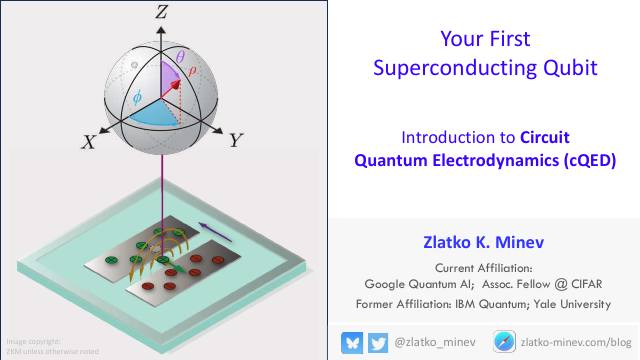
Dirac's canonical quantization and ladder operators lead to a description of the transmon as a weakly nonlinear (Kerr) oscillator. Modeling real devices then proceeds through classical EM simulation, quantization (with energy-participation ratios as the worked example), and an effective Hamiltonian with dispersive shifts. Backup slides include handwritten notes on energy, flux fluctuations and the compactness of the junction phase.
Transmon as a Kerr oscillator: to first order (in the RWA) the nonlinearity shifts energies, giving anharmonicity and a Lamb shift, while the Fock eigenstates are unchanged
Three-step device modeling: EM eigenmodes, quantization via EPR, and the effective qubit-cavity Hamiltonian with cross-Kerr chi
Backup notes on flux fluctuations, harmonic approximation and a tight-binding picture of the junction phase
Summary and key points drafted by a language model from the slides, not yet reviewed by me. The slides are the source.
From the blog · 2025-07-30Lectures on Superconducting qubits 101: making your first qubit - QDW School
Earlier this summer, I had the pleasure of giving a beginner-track talk at the first-ever Quantum Device Workshop at UCLA, hosted by the Quantum Computing Student Association.
In the session, I introduced the physics behind superconducting qubits and how to build a basic qubit–oscillator system from scratch. It was a joy to break this down in an intuitive way for a broad audience of learners—students, early-career researchers, and fellow curious minds alike.
I'm excited to see the QCSA team now releasing talks from the workshop publicly, week by week! If you're curious about quantum devices—or looking for an entry point into superconducting qubit design—check out the video:
Big thanks to the organizers, volunteers, and students at UCLA for bringing together such a vibrant community. I’m already looking forward to what next year’s workshop will bring.
📌 Pre-register for 2026 here: https://lnkd.in/g6-hS7iZ
Some slides include figures, photos, logos or excerpts from other people and institutions, credited where they appear. Those aren't mine to license, so please ask the original source. Spotted a missing credit? Tell me and I'll fix it.