Zlatko K. Minev

← Browse everything in the Notebook

Research Talks

Machine Learning for Practical Quantum Error Mitigation (ML-QEM)

Zlatko K. Minev

Research talk · 2025 · Aspen AI plus Quantum · 60 pages

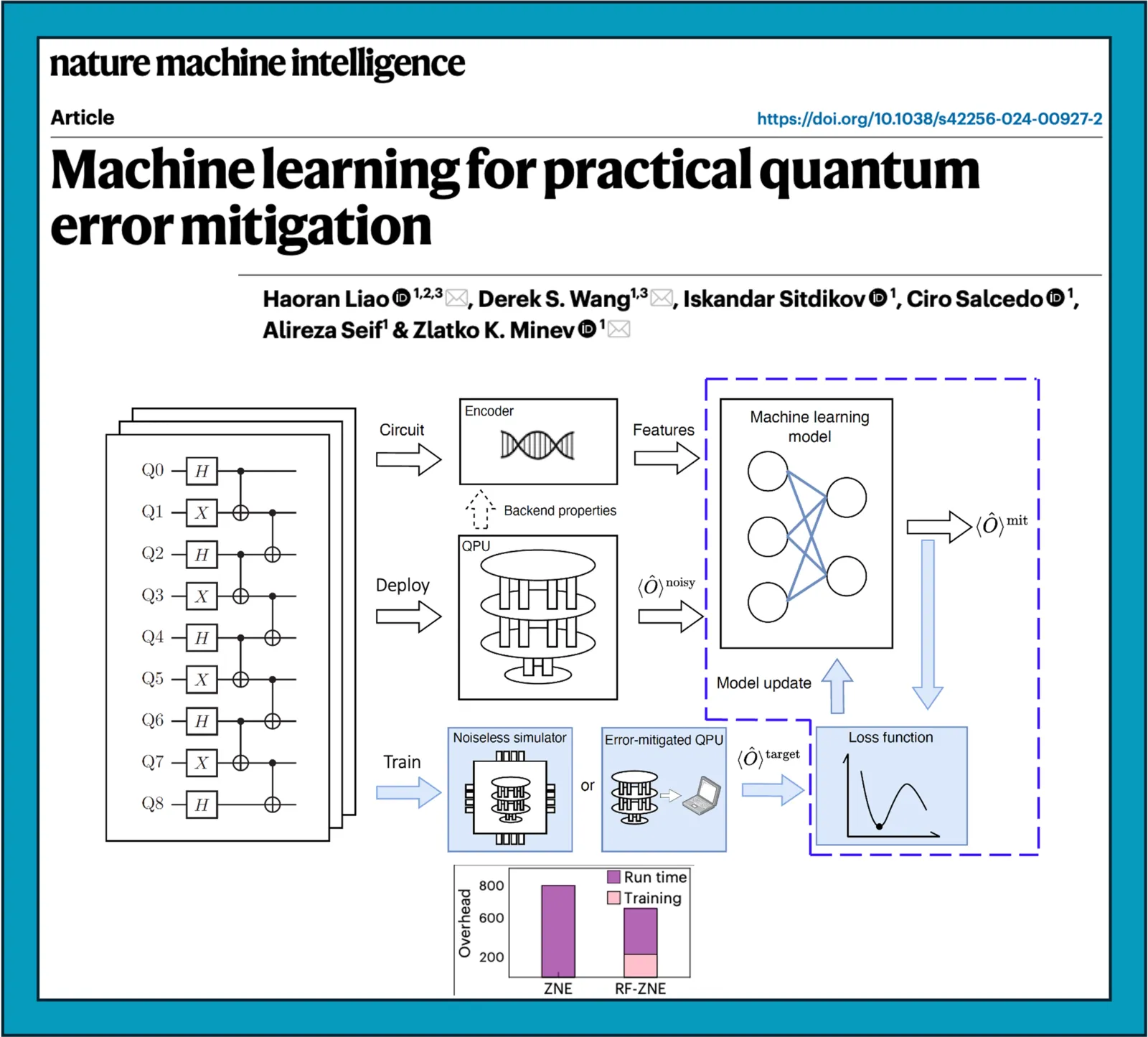
Error mitigation enables utility-scale experiments, but physics-based methods such as ZNE and PEC face a sampling-overhead bottleneck. ML-QEM learns the map from noisy to ideal expectation values using circuit features, with comparisons across models, adaptation to noise drift, and analysis of why the approach works. Code and documentation are open source.

  • Utility-scale experiments on superconducting processors and the role of error mitigation
  • Limits of ZNE and PEC: sampling overhead and the complexity of quantum noise
  • ML-QEM models (linear regression, random forest, MLP, GNN); random forest performs best
  • Fine-tuning to time-varying noise, and why learning classical output relationships can succeed

Summary and key points drafted by a language model from the slides, not yet reviewed by me. The slides are the source.

From the blog · 2024-01-11Machine Learning for Practical Quantum Error Mitigation

Published in Nature Machine Intelligence today, we've been working on how to get the most out of a quantum computer using machine learning. Excited to share it!

"Machine Learning for Practical Quantum Error Mitigation"
by the dream team: Haoran Liao, Derek S. Wang, Iskandar Sitdikov, Ciro Salcedo, Alireza Seif, Zlatko Minev

🔍 Context:
Quantum computers progress to outperform classical supercomputers, but quantum errors remain the primary obstacle.  Quantum error mitigation offers a solution but at the high cost of added runtime.

🤔 Key Question:
Can classical machine learning help us overcome errors in today's quantum computers by lowering mitigation overheads, in practice, on real hardware, at the 100 qubit+ scale?

🔬 Our Findings:
Using both simulations and experiments on state-of-art quantum computers (up to 100 qubits), we find that machine learning for quantum error mitigation (ML-QEM) can:

- Significantly reduce overheads.
- Maintain or even outperform the accuracy of traditional methods.
- Deliver nearly noise-free results for quantum algorithms.

We tested multiple machine learning models on various quantum circuits and noise profiles. And, by leveraging ML-QEM, we were able to mimic conventional mitigation results for large quantum circuits, but with much less overhead.

🌟 Conclusion:
Our research underscores the potential synergy between classical hashtag#ML and hashtag#AI and quantum computing. We're excited about the prospects and further research!

🙌 Big thanks to the dream team and many folks who contributed!

Let’s share and discuss the implications of this exciting work! 🌟👇

📄 Paper: Nature Machine Intelligence https://lnkd.in/dGYzC3fq
🔓 Free access: View the paper here https://lnkd.in/dN222X7D
📚 Preprint on arXiv https://lnkd.in/dGbzjtjA

👩‍💻 Code Repository: Explore on GitHub https://lnkd.in/dcn-xPtm
🎥 Seminar: Watch hashtag#IBM @Qiskit on YouTube here https://lnkd.in/dEPRcMVK

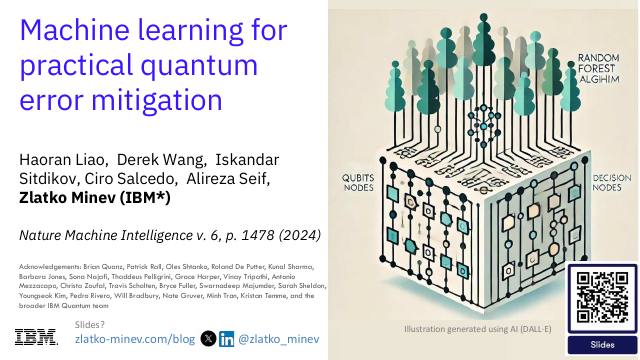
Slides from Machine Learning for Practical Quantum Error Mitigation (ML-QEM) talk at IBM Seminar
Cite

@misc{minev2025machinelearning,
  author = {Zlatko K. Minev},
  title = {{Machine Learning for Practical Quantum Error Mitigation (ML-QEM)}},
  howpublished = {Talk, Aspen AI plus Quantum},
  year = {2025},
  url = {https://www.zlatko-minev.com/notebook/items/2025-machine-learning-for-practical-quantum-error/},
  note = {Slides}
}

Reuse

Unless a deck says otherwise, the slides and notes here are © Zlatko K. Minev and shared under CC BY-NC-ND 4.0: you're welcome to read, download and share them, unchanged and non-commercially, with credit and a link back. Commercial use or a reworked slide or figure in your own talk, course or paper needs permission; please ask, the answer is usually yes. If you use something in teaching or a publication, I'd love a short note telling me where.

Some slides include figures, photos, logos or excerpts from other people and institutions, credited where they appear. Those aren't mine to license, so please ask the original source. Spotted a missing credit? Tell me and I'll fix it.

First page of Machine Learning for Practical Quantum Error Mitigation (ML-QEM)