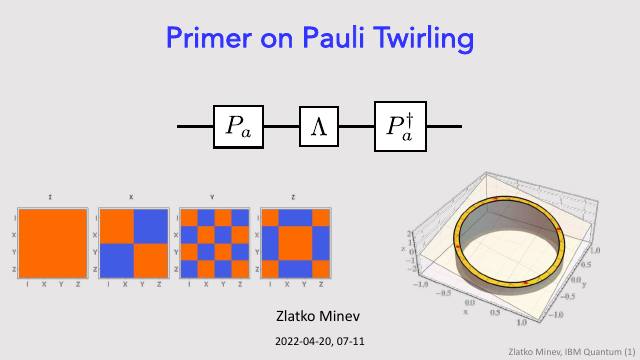
Begins operationally by sandwiching a noise channel between random Paulis and showing, with an amplified coherent over-rotation, how twirling scrambles coherent errors. It then sets up notation for easy and hard gate cycles in a noisy circuit and shows how twirls are inserted, conjugated through hard gates and compiled into neighboring single-qubit gates, ending with a summary of why twirling is used in practice.
Twirling a CPTP noise channel over the Pauli group
Coherent over-rotation example and how twirled errors stop adding coherently
Noisy-circuit cycles of easy and hard gates, and conjugating twirls through Clifford layers
Practical uses: randomized compiling, PEC, and efficient Clifford simulation of Pauli noise
Summary and key points drafted by a language model from the slides, not yet reviewed by me. The slides are the source.
From the blog · 2022-09-12A tutorial on tailoring quantum noise - Twirling 101 (Parts I–IV)
Please find attached a draft of my slides on a nutshell introduction to tailoring quantum noise by twirling into stochastic Pauli or other channels. You can view and download the pdfs below.
I gave a series of these tutorials over a few days that took about 4.5 hours to cover with avid questions.
Let me know in the comment section any thoughts you may have.
Enjoy and Good Luck!
Part I - Operational introduction to Pauli Twirling
Part II - Theory of Pauli Twirling
Part III - Pauli twirling as a super-superoperator - masking
Part IV - Designs & Basic Noise Channels refresher
Cite
@misc{minev2022primerpaulitwirling,
  author = {Zlatko K. Minev},
  title = {{Primer on Pauli Twirling (tutorial)}},
  howpublished = {Lecture series},
  year = {2022},
  url = {https://www.zlatko-minev.com/notebook/series/primer-on-pauli-twirling-tutorial/},
  note = {Slides, 4 decks}
}
Some slides include figures, photos, logos or excerpts from other people and institutions, credited where they appear. Those aren't mine to license, so please ask the original source. Spotted a missing credit? Tell me and I'll fix it.