Lectures & Tutorials
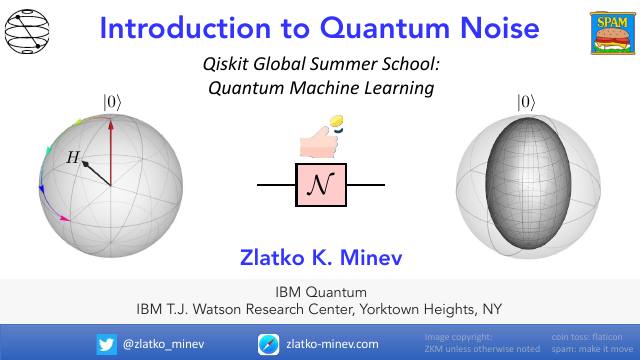
Intro to Quantum Noise
Part of the series Intro to Quantum Noise (QGSS 2021); cited as one entry below.
A 'hello world' experiment that flips a qubit d times illustrates sources of disagreement between ideal and measured data. A miscalibrated rotation illustrates the quadratic impact of coherent errors on algorithmic accuracy in the worst case. Other topics include projection noise with finite shots, state-preparation and readout errors, and bit-flip, phase-damping, depolarizing and stochastic Pauli channels, with exercises on error-amplification sequences and sample variance.
- Gates from time evolution and a miscalibrated RX(π+ε) gate on the Bloch sphere
- Why coherent errors have a quadratic impact, plus a two-qubit ZZ error example
- Projection and sampling noise, readout error and thermal state preparation
- Incoherent channels: bit-flip, phase damping, depolarizing and stochastic Pauli noise
Summary and key points drafted by a language model from the slides, not yet reviewed by me. The slides are the source.
Cite
@misc{minev2021quantumnoiseqgss,
  author = {Zlatko K. Minev},
  title = {{Intro to Quantum Noise (QGSS 2021)}},
  howpublished = {Lecture series, Qiskit Global Summer School},
  year = {2021},
  url = {https://www.zlatko-minev.com/notebook/series/intro-to-quantum-noise-qgss-2021/},
  note = {Slides, 6 decks}
}Reuse
Unless a deck says otherwise, the slides and notes here are © Zlatko K. Minev and shared under CC BY-NC-ND 4.0: you're welcome to read, download and share them, unchanged and non-commercially, with credit and a link back. Commercial use or a reworked slide or figure in your own talk, course or paper needs permission; please ask, the answer is usually yes. If you use something in teaching or a publication, I'd love a short note telling me where.
Some slides include figures, photos, logos or excerpts from other people and institutions, credited where they appear. Those aren't mine to license, so please ask the original source. Spotted a missing credit? Tell me and I'll fix it.